Reliable battery packs are not created by one final inspection. They are created by a connected control plan that begins with the product requirement and continues through incoming materials, assembly, electrical testing, aging, documentation, and shipment release.
Quality starts before production
A stable production result begins with a controlled specification. Voltage, capacity, load current, peak current, charge method, dimensions, connector, wire length, temperature range, enclosure, communication, labeling, and compliance targets should be agreed before the bill of materials is released.
For an OEM battery project, the drawing and approved sample become practical control references. When a connector, cell model, protection threshold, or insulation material changes, the change should be reviewed rather than silently introduced on the production floor.
Incoming cell and component control
Cells are checked against the approved manufacturer, model, date code, appearance, voltage, internal resistance, and capacity plan. Matching matters because cells connected in series or parallel need sufficiently consistent behavior to share current and reach charge and discharge limits predictably.
The same discipline applies to protection boards, nickel strips, wires, connectors, thermal sensors, housings, insulation materials, labels, and packaging. A battery pack can fail because of a small mechanical or connection detail even when the cells themselves are acceptable.
Assembly controls that protect consistency
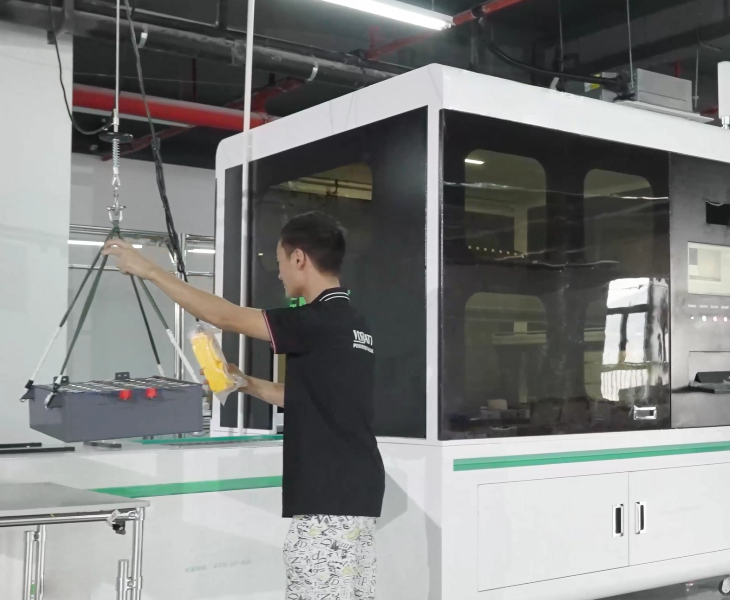
Welding energy, electrode condition, strip position, polarity control, insulation placement, wire routing, soldering temperature, connector orientation, and fastening torque are production variables that need defined limits. Work instructions and first-piece approval help operators confirm the process before a batch continues.
Mistake-proof fixtures, barcode checks, polarity detection, and visual standards reduce dependence on memory. These controls are especially important for custom packs because product configurations may look similar while using different wiring or protection settings.
Electrical testing, aging, and final inspection
Completed packs should be verified for open-circuit voltage, polarity, protection operation, charge and discharge behavior, insulation, communication where applicable, and physical dimensions. Higher-risk projects may also require load testing, temperature checks, vibration, drop, or enclosure validation.
Aging allows the factory to observe abnormal self-discharge, unstable connections, or early component failures before shipment. Final inspection then confirms appearance, label, connector, pack voltage, accessories, packaging, and shipment documentation.
Traceability and continuous improvement
Traceability connects finished packs to production date, material lot, cell batch, inspection records, and operators or equipment. When a field issue occurs, these records make the investigation narrower and faster.
Quality data should also feed process improvement. Repeated defects, test failures, and customer feedback are more useful when they lead to updated drawings, fixtures, inspection limits, training, or supplier controls.
| Control point | Typical checks | Why it matters |
|---|---|---|
| Incoming cells | Model, voltage, resistance, capacity plan, appearance | Reduces cell imbalance and material variation |
| Pack assembly | Polarity, welding, insulation, wiring, connector | Prevents connection and mechanical failures |
| Electrical test | Voltage, load, protection, charging, communication | Confirms the pack works as designed |
| Aging and release | Self-discharge, appearance, label, packaging | Screens early failures before shipment |
A final pass result does not replace process control. The objective is to make the correct result repeatable from material receipt to shipment.
Related battery resources
Continue from the technical overview to relevant VTCBATT product and engineering resources.
Frequently asked questions
Why is cell matching important?
Matched cells reduce imbalance in series and parallel assemblies and help the protection system operate more predictably.
Does every battery pack need an aging process?
The duration and method depend on chemistry, design, risk, and customer requirements, but aging is a useful screen for abnormal self-discharge and early failures.
What records should an OEM customer request?
Approved drawings, specifications, critical BOM controls, inspection criteria, test reports, and lot traceability are practical starting points.